
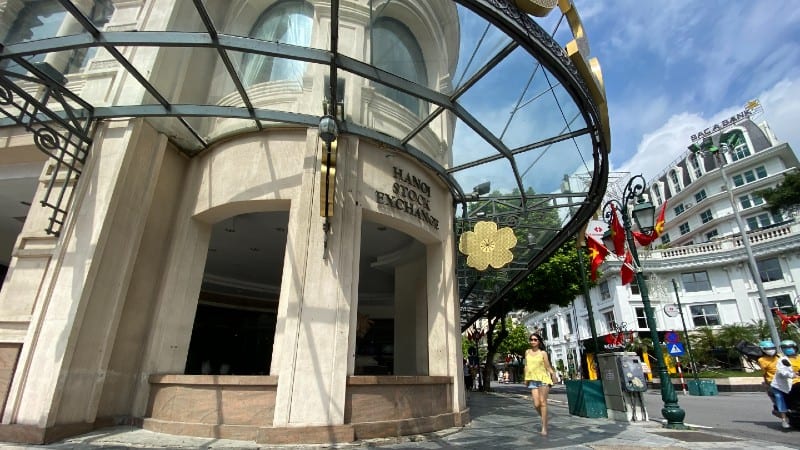
Vietnam’s stock market may soon see longer trading hours, as the exchange is studying a proposal to extend afternoon sessions starting in the first quarter of 2026 — a move expected to boost liquidity and align with global market practices.
The idea of extending trading hours is not new. Two years ago, a senior expert at KB Securities Vietnam suggested pushing the close to 4:00 p.m., with the goal of increasing daily liquidity to VND 30 trillion (USD 1.18 billion) per session.
Foreign Fund Performance Surges on Banking and Brokerage Bets
The announcement comes as Finnish investment fund Pyn Elite reported a 13.2% return in July 2025 — its strongest monthly performance in nearly five years, since April 2020. The VN-Index climbed 9.2% in the same month, closing above the 1,500-point mark.
The fund’s gains were driven by its heavy weighting in the banking sector and its decision to double holdings in two brokerage stocks — VIX and SHS — which surged 114% and 78% in July, respectively.
Pyn Elite noted: “The Stock Exchange has raised the issue of extending afternoon trading hours from Q1 2026 and introducing a central counterparty (CCP) system in Q1 2027. These will be major steps toward enabling intraday trading. The State Securities Commission believes Vietnam could achieve emerging market (EM) status this autumn, as FTSE has given positive feedback on recent market reforms.”
Why Trading Hours Matter for Liquidity
When KB Securities first floated the proposal in 2023, the VN-Index was hovering around 1,150 points amid expectations of supportive policies — such as interest rate cuts, public investment disbursements, and measures to ease stress in the bond and real estate markets. At that time, billion-dollar trading sessions were rare, limiting Vietnam’s ability to attract large-scale capital inflows.
The KB expert emphasized that beyond macroeconomic conditions and corporate earnings growth, session length directly impacts market liquidity — especially after the T+2.5 settlement cycle was introduced on August 29, 2022.
“Retail investors tend to trade quickly and often finish by 10:30 a.m., which is also when the market’s momentum typically dips. In contrast, large institutional flows are more active in the afternoon, especially after 2:00 p.m.,” he said.
Back then, average daily liquidity stood at around VND 20 trillion per session. Despite the shorter duration, afternoon trading — just 1 hour 45 minutes compared to 2 hours 30 minutes in the morning — often accounted for 1.5 to 2 times the value of the morning session.
“In a T+2.5 environment, most large players prefer to trade in the afternoon, when newly settled shares hit accounts. This is when the ‘big battles’ happen and when institutional investors can better manage risk,” the expert added.
As of August 11, 2025, the VN-Index closed near 1,597 points. Average daily liquidity on HoSE over the past two weeks has ranged between VND 40–60 trillion per session, signaling robust participation from both domestic and foreign investors.
Related
Discover more from Vietnam Insider
Subscribe to get the latest posts sent to your email.
Source: Vietnam Insider