
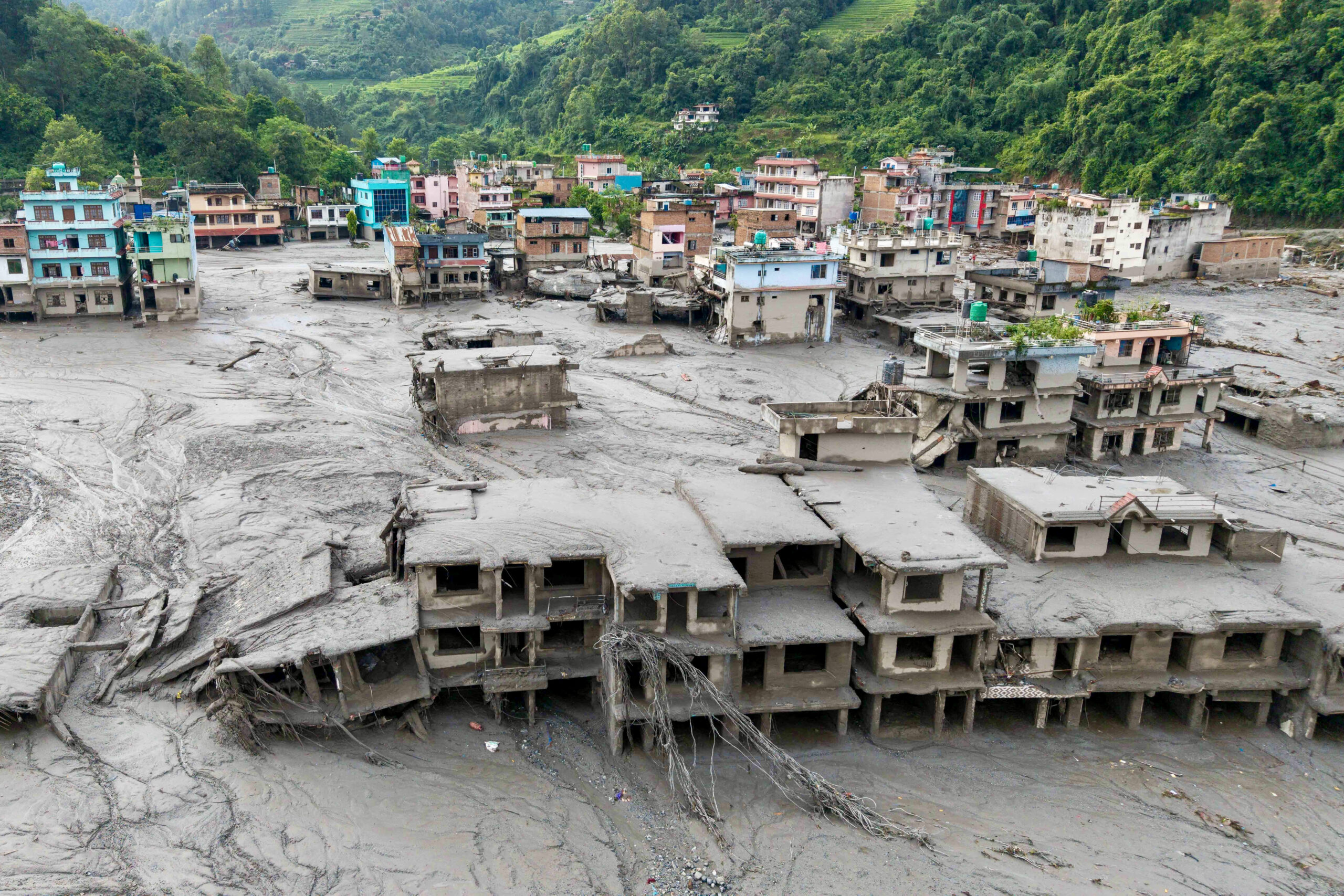
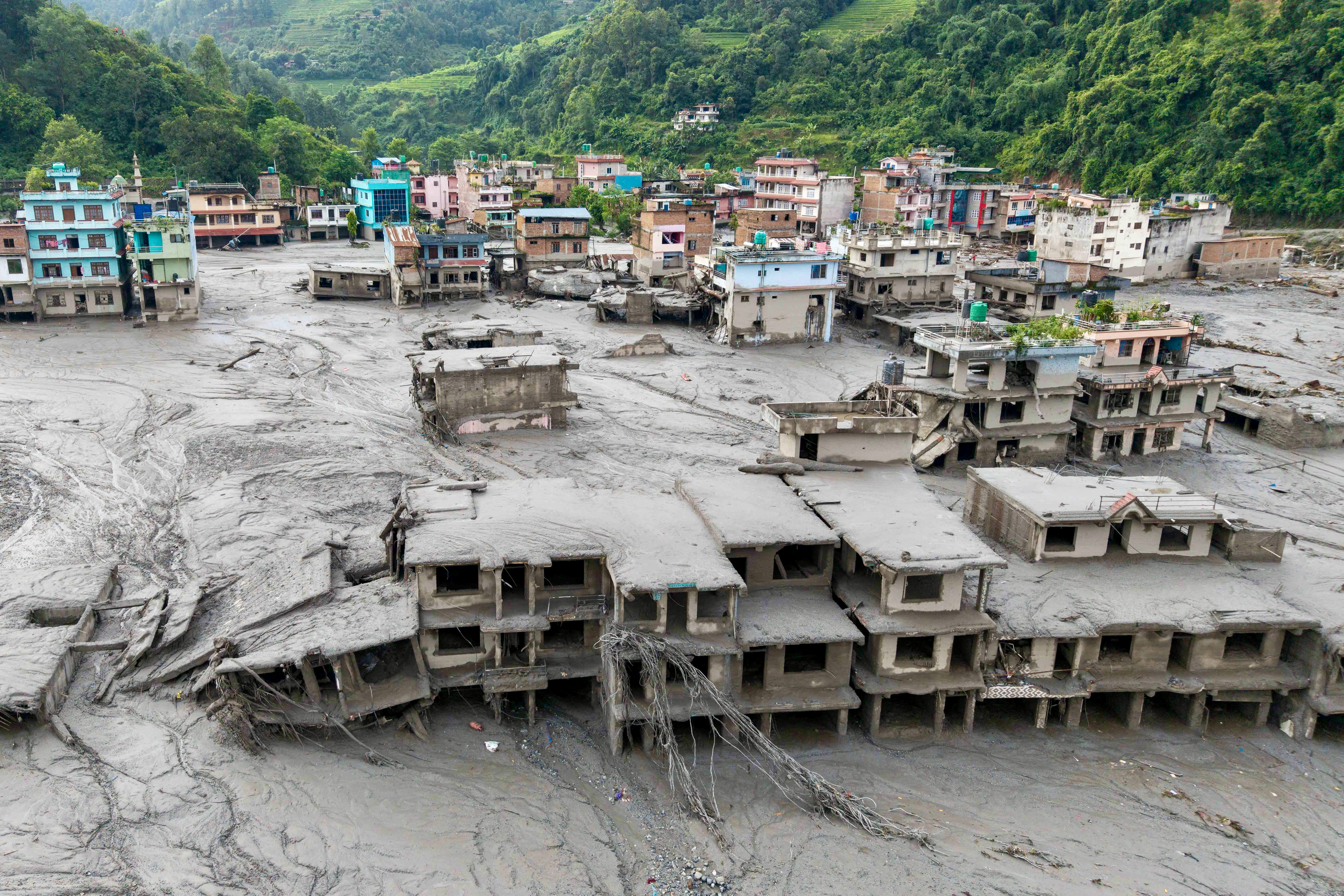
Nepal’s renowned adventure tourism industry faces a sobering reality check, according to local mountain tourist associations and hostel owners, following devastating flooding on Nepal’s border with China.
The death toll from last week’s disaster, which tore through villages along the Nepal-Tibet border, stood at 987, authorities said Tuesday. Nearly 4,250 people were missing, they added.
The catastrophe began on Aug. 26 in the Himalayas, a mountain range that contains some of the world’s highest peaks, including the highest, Mount Everest.
A massive glacial collapse in northern Nepal triggered a landslide of ice and rock and meltwater into the valleys below, with powerful floods sweeping away or cutting off entire communities and damaging roads, bridges and hydropower facilities.
The tragedy, which prompted Nepali Prime Minister Balendra Shah to push for international climate action, underscores the growing impact of climate change on adventure tourism.
Rajendra Bahadur Lama, general secretary of the Nepal Mountaineering Association, described the floods as a “serious warning” for Nepal’s tourism industry.
“This disaster should not be seen as the end of Nepal’s adventure tourism; it should be a wake-up call,” Lama told CNBC in an email. “Climate change is changing the Himalayas, and Nepal must now build a tourism industry that is not only adventurous, but safer, smarter and climate-resilient.”
Read more
Tourism infrastructure, routes and destinations will need to be assessed and redesigned with better protection for floods, landslides and other extreme events, Lama said, noting that international tourists are “increasingly conscious” of climate change and safety.
Counting the cost
To rebuild from the catastrophe, Nepal, one of the least developed countries in South Asia, has reportedly estimated a cost of between $4 billion and $5 billion, equivalent to nearly one-tenth of its economy.
The tourism industry is a core tenet of the Nepalese economy and serves as a major source of foreign exchange and revenue. The country of nearly 30 million is world-renowned as a hotspot for trekking and mountaineering, as well as a premier global destination for spiritual travel.
Tourists have cancelled bookings in the last several days, however, just as Nepal heads into its most popular travel season from Sept. 15 to Nov. 15, said Saroj Bhandari, owner of the Wander Thirst hostel in the capital city of Kathmandu, more than five hours’ drive from the flood site.
Bhandari expects that, at best, his 122-bed hostel will reach 60% occupancy during that peak tourist season this year, down from 100% last year. Most of the cancellations have come from European tourists, he said.
“This time only the one part of Nepal is little damaged by the flood and a lot of the tourists think it’s not safe to go to Nepal because of that,” he said, noting the country does not only consist of mountains but also flatland.
Bhandari said Nepal is nearing the end of its rainy monsoon season. He emphasized the government’s system for landslide alerts and road closures, noting the state typically shares warnings about floods and landslides with the hostel every day, which the hostel then passes on to guests.
While he was not aware whether China had sent an alert, Bhandari said people who first saw the flood had warned those living downstream of it, but that those downstream had underestimated its size.
A spokesperson for Nepal’s government was not immediately available to respond when contacted by CNBC. China’s Foreign Ministry, meanwhile, has said it is preparing a third batch of emergency aid for Nepal and will continue to “stand firmly together” with its neighboring country.
Tibet Vista, a regional tour organizer with offices in Nepal and China, meanwhile, said in a statement to CNBC that all its travelers and team members were safe.
“None of our guests were at Gyirong Port when the flooding occurred, and no travelers with Tibet Vista were affected by the disaster,” Tibet Vista said Monday. “We are deeply saddened by what happened, and our thoughts are with the victims, their families, and everyone affected by this tragedy.”
Severe glacial flood risks
The U.S. embassy in China on Aug. 30 noted the risk of further landslides and flooding due to additional rainfall through Sept. 1. Beijing had sent Premier Li Qiang to visit the flood site on Aug. 27 and focused a regular month-end meeting of top leaders on response to the catastrophe, with a readout noting the disaster occurred in a cold plateau region surrounded by glaciers and potential hazards.
An assistant secretary-general at the United Nations on Tuesday warned that millions of people in the Himalayan region were at risk from glacial floods, with fears that entire riverbanks might become effectively uninhabitable.
“Technology cannot move fast enough to prevent loss along these massive river systems that catch the overflow of the glacier lakes,” Kanni Wignaraja, an assistant secretary-general at the U.N., told Reuters in an interview.
Researchers have previously identified 47 dangerous glacial lakes in Nepal, China and India, although the real number has since been estimated to be far higher.
“The devastating impacts of the Nepal floods cannot be understated,” Carlo Buontempo, director of the European Union’s Copernicus Climate Change Service (CS3), told CNBC by email.
“While the precise chain of events that led to this disaster will take time to reconstruct, the wider picture is already clear: the world’s frozen regions are losing mass, and as they do, they are becoming less stable.”
Indeed, as the climate warms, Buontempo said the loss of glacial ice around the world would have important consequences for mountainous landscapes.
“Glaciers buttress the slopes around them; frozen ground holds fractured rock in place; meltwater collects in lakes behind fragile natural dams. As the ice thins and the permafrost thaws, mountains that were held together for millennia begin to loosen their grip,” he added.
This process typically happens slowly, but sometimes it can happen suddenly — such as when a massive ice and rock collapse onto Switzerland’s Birch Glacier buried the Alpine village of Blatten in May last year.
“The Nepal floods underscore the importance of continued satellite monitoring for early-warning signs, to inform future risk planning and be able to save villages, as in the case of Blatten where residents were evacuated before the landslide. It is evident that the climate of the past has shifted – we must redouble our efforts in preparing for the future,” Buontempo said.
Source: CNBC