
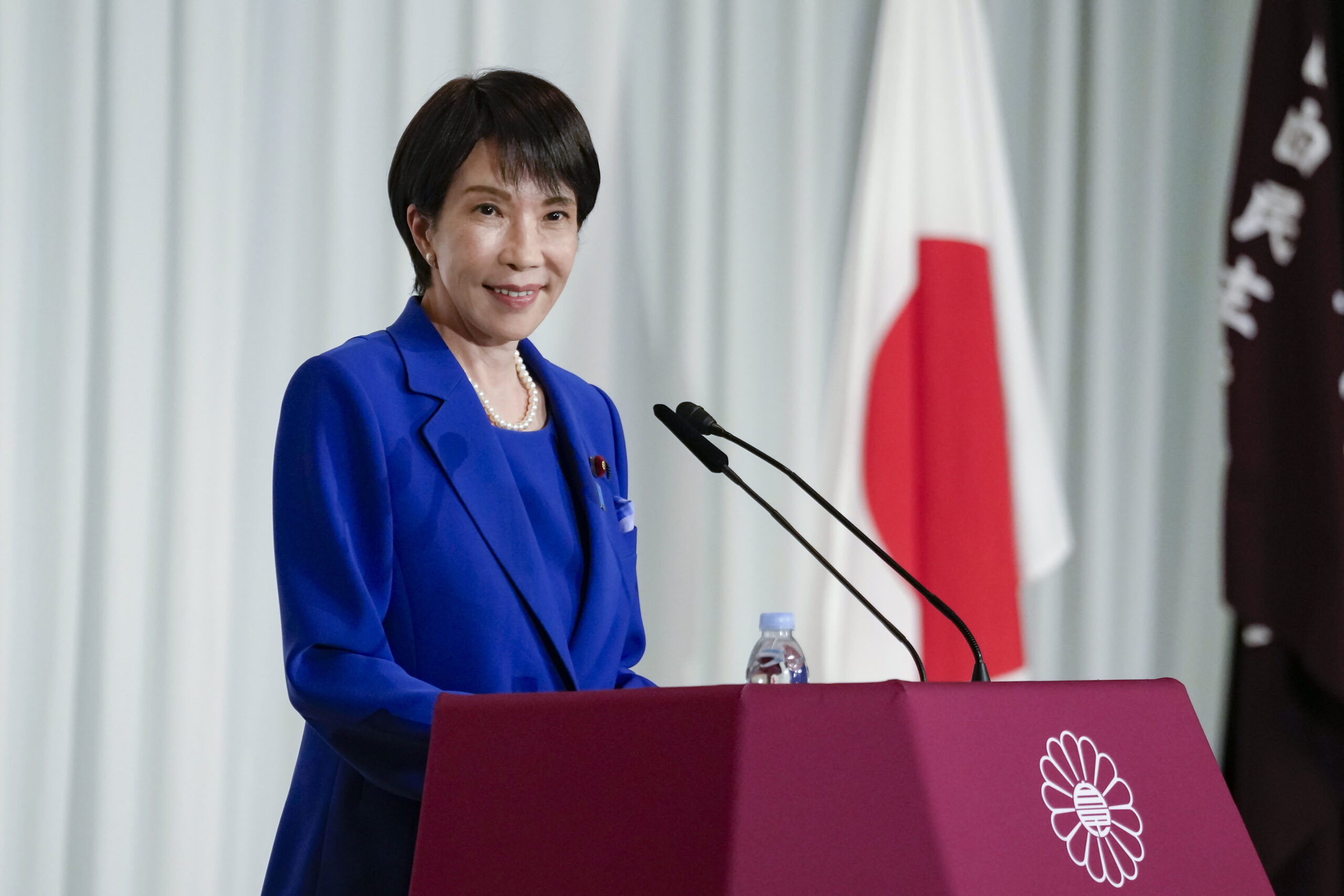
Japan’s Nikkei 225 index jumped over 4% to hit a record high Monday after the country’s ruling Liberal Democratic Party elected staunch conservative Sanae Takaichi as its new leader Saturday, positioning her to become the country’s first female prime minister. The index closed 4.75% higher to end the trading day at 47,944.76.
The surge was led by gains in real estate, technology and consumer cyclical stocks. Yaskawa Electric Corp jumped over 20%, while Japan Steel Works was up 14%. Mitsubishi Heavy Industries and Kawasaki Heavy Industries added 13% and 12% respectively.
Given the government’s economic policy of a “high-pressure economy,” Takaichi is likely to ask the Bank of Japan to maintain its accommodative monetary policy, Crédit Agricole CIB wrote in a note over the weekend following the results, adding that she would be open to a 25-basis-point rate hike by the BOJ by January 2026.
“A Takaichi administration, recognising that the current economy is still weak, is expected to completely shift policy direction to a new approach (complete overhaul) that seeks to expand investment and demand through public-private partnerships,” CA-CIB’s note said.
Similarly, the Topix rose as much as 3.1% to hit an all-time high, ending at 3,226.06.
The yen weakened by over 1.81% to hit the psychological mark of 150 against the greenback.
The last time the yen weakened to the 150-level was in August, according to data from LSEG, raising concerns from Japan’s finance minister Katsunobu Kato. In October 2022, the yen briefly weakened beyond the 151 mark against the dollar, which prompted an intervention by the country’s Ministry of Finance.
Loading chart…
“Our base case is for near-term losses in the JPY towards 150 as the market adjusts to the surprise, but not material weakness beyond,” Deutsche Bank wrote in a note published Monday.
While the probability of a hike by the Bank of Japan in October should fall, the market has only been pricing a terminal rate around 1%, which may still be achievable under Takaichi’s leadership.
“A weak yen has been contributing to domestic concerns from overtourism to property price, so further weakness from already depressed levels could be unwelcome even for the government,” the analysts added.
Japan’s 30-year bond yield rose over 10 basis points to 3.263%, while the yield on the 20-year debt added over six basis points to 2.674%. The benchmark 10-year bond yield is little changed at around 1.659%.
Australia’s ASX/S&P 200 closed flat at 8,981.4.
Hong Kong’s Hang Seng Index fell 0.22%, while the Hang Seng Tech Index declined 0.66%.
Chinese and South Korean markets were closed for holidays.
Last Friday in the U.S., the three major averages saw a positive weekly finish. The S&P 500 retreated from a record on Friday, ticking up just 0.01% at 6,715.79, but held on to solid weekly gains of 1.1% despite a U.S. government shutdown dragging on for a third day.
The Nasdaq Composite declined 0.28% Friday to settle at 22,780.51, but capped the week 1.3% higher. The Dow Jones Industrial Average outperformed, trading higher by 238.56 points, or 0.51%, to finish at 46,758.28, and was up 1.1% for the week. The Russell 2000 also popped 0.72% Friday to close at 2,476.18, and 2% higher for the week.
— CNBC’s Pia Singh and Sean Conlon contributed to this report.
Correction: This story has been updated to correct that the three major U.S. indexes ended the week higher on Oct. 3. A previous version misstated the period.
Source: CNBC