
On October 17, the 23rd World Congress of Chinese Medicine grandly opened in Singapore. The 2026 Academic Annual Meeting of the World Federation of Chinese Medicine Societies (WFCMS) Specialty Committee of Luobing and the Overseas Forum of the 22nd International Congress on Luobing Theory were held concurrently. The forum brought together experts and scholars from more than ten countries, including China, Singapore, Vietnam, Thailand, Malaysia, United States and the United Kingdom. Participants shared insights into the clinical applications of Luobing Theory and advances in Luobing research, and presented outstanding transformation achievements based on the theory to further promote the high-quality development and global expansion of TCM.
Luobing Theory Has Forged a Successful Path: “Inheriting Tradition without Being Bound by It, Innovating without Departing from the Essence”
At the opening ceremony, Pan Ping, Deputy Secretary-General of the WFCMS, pointed out that the WFCMS is the world’s largest international academic organization for TCM, and its branches are important components and key drivers for promoting the high-quality international development of TCM. Since its establishment in 2012, under the leadership of Academician Wu Yiling of the Chinese Academy of Engineering and with the joint efforts of the council members, the Specialty Committee of Luobing of the WFCMS has promoted the comprehensive construction of the Luobing discipline. The International Congress on Luobing Theory has been successfully held 22 times. Its Overseas Forum has been successfully held twice in Thailand and Vietnam. This year, held in Singapore as a sub-forum of the World Congress of Chinese Medicine, it has a wide-reaching impact and serves as an important platform for promoting Luobing academic exchanges and innovative collaboration between Chinese and Western medicine.
Pan Ping expressed the hope that the Specialty Committee of Luobing will make persistent efforts and forge ahead, achieving greater accomplishments in organizational construction, academic exchanges, standard development, talent cultivation and international development, thereby making new and greater contributions to building a global community of health for all!
Chew Wai Khuen, Vice Chairman of the Board of Directors of the Singapore College of Traditional Chinese Medicine, pointed out that Luobing Theory is a highly representative example of TCM inheritance and innovation. The research team led by Academician Wu Yiling has conducted decades of in-depth research, systematically excavating, organizing, and refining the Luobing ideas scattered across ancient texts, and has established a comprehensive Luobing theoretical system. This system not only profoundly reveals the onset and progression of major diseases such as cardiovascular, cerebrovascular, and respiratory diseases, but also explains the mechanisms underlying TCM efficacy in the language of modern science. From the development and launch of Tongluo medications to the publication of evidence-based findings in leading international journals, Luobing Theory has forged a successful path: inheriting tradition without being bound by it, and innovating without departing from the essence, allowing TCM to shine with the brilliance of modern science on the global stage.
The English Version of the Expert Consensus on Intervention in the Cardiovascular Continuum with Chinese Medicine Formulas Based on Luobing Theory Officially Published
Notably, the English version of the Expert Consensus on Intervention in the Cardiovascular Continuum with Chinese Medicine Formulas Based on Luobing Theory was officially published at the opening ceremony. Bringing together 115 experts from five countries, the consensus focuses on five major therapeutic areas and seven categories of patients, providing an integrated Chinese and Western medicine treatment plan with Chinese characteristics for systematic intervention in the cardiovascular continuum worldwide.
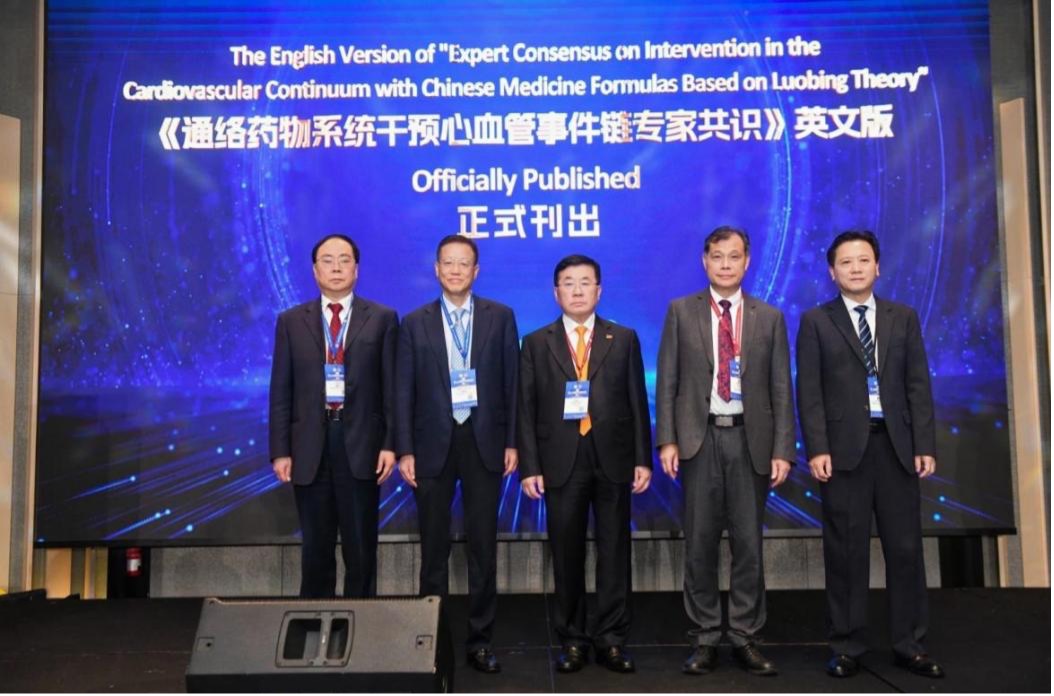
The English version of the Expert Consensus on Intervention in the Cardiovascular Continuum with Chinese Medicine Formulas Based on Luobing Theory is officially published.
Focusing on major diseases at key pathological stages of the cardiovascular continuum, the consensus addresses current bottlenecks in disease progression while controlling upstream risk factors and preventing the disease from progressing downstream. It thus forms a systematic intervention scheme in which prevention is embedded in treatment and treatment in prevention—an integrated approach to both—helping to fundamentally interrupt the cardiovascular continuum and reduce cardiovascular morbidity and mortality.
During a keynote report at the main session of the 23rd World Congress of Chinese Medicine, Academician Zhang Yun of the Chinese Academy of Engineering introduced that the consensus covers the mechanisms of action and clinical evidence of a series of Tongluo Chinese medicines (including Jinlida, Tongxinluo, Shensong Yangxin, and Qili Qiangxin) in the systematic intervention of diseases related to the cardiovascular continuum, such as diabetes and prediabetes, stroke, coronary heart disease, arrhythmia, and heart failure. It summarizes expert clinical experience, incorporates evidence-based data, and, in accordance with European Society of Cardiology standards, provides recommendations and levels of evidence for integrated Chinese and Western medicine treatment at each key stage of the cardiovascular continuum. Much of this clinical evidence derives from major research achievements of the National Key R&D Program “Research on Systematic Intervention in the Cardiovascular Continuum Guided by Mailuo Theory and Ying-Wei Theory”, including Jinlida’s breakthrough in TCM for preventing type 2 diabetes; Tongxinluo’s gold-standard clinical imaging evidence for stabilizing vulnerable coronary plaques; Tongxinluo’s improvement of post-myocardial infarction prognosis (a major international breakthrough in drug therapy over the past decade); Shensong Yangxin’s resolution of the challenge of postoperative atrial fibrillation recurrence and optimization of the pharmacological treatment regimen; and Qili Qiangxin’s new breakthrough in integrated Chinese and Western medicine for improving heart failure prognosis. These findings have been published in leading international medical journals, including JAMA Internal Medicine, Signal Transduction and Targeted Therapy, JAMA, Nature Medicine and the European Heart Journal. Their publication marks a milestone breakthrough in the internationalization of TCM and has generated significant impact.
Luobing Theory Innovative Transformation Yields Fruitful Results, Drawing Enthusiastic Responses from Experts Worldwide
During the academic keynote session, Academician Wu Yiling of the Chinese Academy of Engineering participated online and delivered a report titled “Construction and Innovative Transformation of the Luobing Theoretical System”. He focused on sharing the innovation and translation achievements of Luobing Theory, as well as the latest scientific breakthroughs in the prevention and treatment of vascular lesions guided by Mailuo Theory, the prevention and treatment of neurological, endocrine, and immune system diseases guided by Qiluo Doctrine, and anti-aging research guided by the Essence-Qi-Spirit Theory of Qiluo Doctrine. His report drew enthusiastic responses from experts in China and abroad.
In addition, authoritative experts from multiple countries, including Academician Zhang Yun of the Chinese Academy of Engineering, Professor Yang Yuejin of Fuwai Hospital, CAMS, Professor Liu Yu of Renmin Hospital of Wuhan University, Professor Lam Su Ping of National Heart Centre Singapore, Professor Li Xinli of the First Affiliated Hospital of Nanjing Medical University, Professor Chi Chunhua of Peking University First Hospital, and Professor Zhang Shunan of China-Japan Friendship Hospital, engaged in in-depth exchanges and discussions on major scientific research progress of Tongluo medications in the fields of cardiovascular and cerebrovascular diseases, respiratory system diseases, and anti-aging. The on-site discussions were lively, creating a vibrant academic atmosphere.
A book donation ceremony for Compendium of Luobing Theory was also held at the opening ceremony. Representatives from the Singapore Chinese Physicians’ Association, the Singapore College of Traditional Chinese Medicine, Nanyang Technological University and Singapore Thong Chai Medical Institution received the books. Compendium of Luobing Theory, a major academic work by Academician Wu Yiling of the Chinese Academy of Engineering, brings together key achievements in Luobing research over the past five decades. It fills the long-standing gap of more than 2,000 years without a systematic Luobing Theory and has been hailed as “the fourth milestone in the history of Luobing Theory development in TCM”. The donation not only builds on and enhances the existing foundation for disseminating Luobing Theory in Singapore but also provides a more comprehensive academic resource for the TCM community in southeast Asia and beyond to understand, study and apply Luobing Theory.
From the publication of the English version of the Expert Consensus on Intervention in the Cardiovascular Continuum with Chinese Medicine Formulas Based on Luobing Theory, to the donation of the Compendium of Luobing Theory to multiple institutions in Singapore, and to the in-depth exchanges among attending experts and scholars on the innovative transformation achievements of Luobing Theory, this forum clearly presents the complete path of Luobing Theory moving from a “Chinese original” to “global sharing”. The overseas expansion of Luobing Theory is not merely the cross-border registration of a single product, but the international expression of a comprehensive academic system. Grounded in theoretical construction, expressed through evidence-based research, standardized by expert consensus, and rooted in overseas education, the internationalization of TCM has made a crucial leap from “being registered” to “being understood”, and from “product trade” to “academic grounding”.