
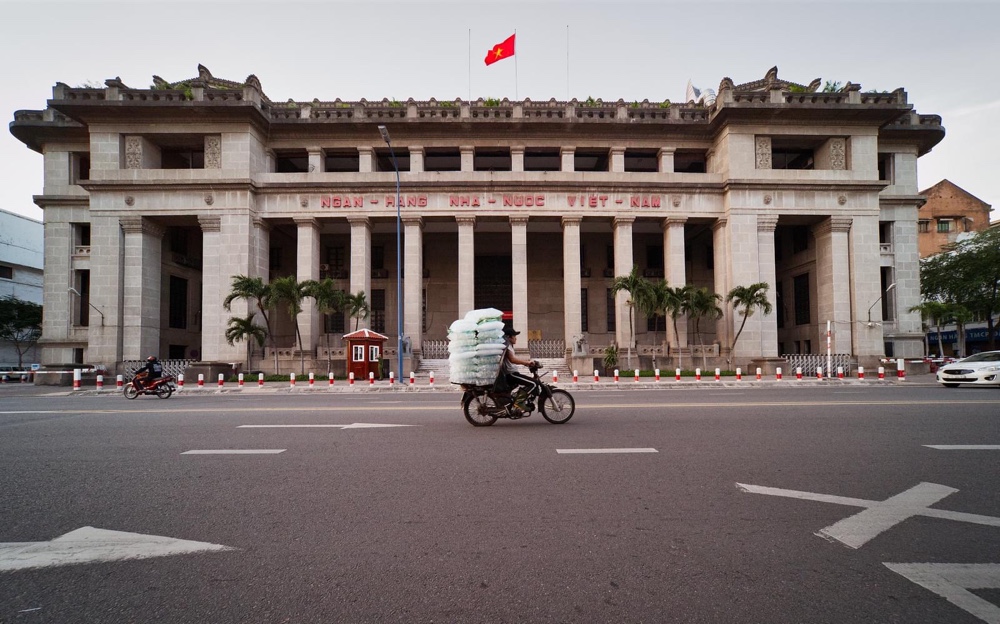
Vietcombank, BIDV and VietinBank could lead earnings growth as accelerating credit and lower provisions boost Vietnam’s banking sector.
Vietnam’s banking sector is heading into a strong third-quarter earnings season, offering investors another signal that credit growth is feeding through to corporate profits in one of Southeast Asia’s fastest-growing economies. Analysts expect several major lenders—including Vietcombank, BIDV, VietinBank, VPBank and Techcombank—to deliver profit growth of more than 20%, although widening differences in funding costs and asset quality mean the gains are unlikely to be shared equally across the industry.
MB Securities (MBS) forecasts combined profit at the 13 listed banks it tracks to increase 19.1% from a year earlier. State-controlled lenders are expected to provide much of that growth, benefiting from relatively low funding costs, improving net interest margins and lower credit-loss provisions. Vietcombank Securities (VCBS) similarly expects stronger lending disbursement to support earnings, with banks financing major infrastructure projects potentially benefiting from policies designed to facilitate liquidity and investment.
Vietcombank is expected to remain the industry’s largest profit generator. MBS forecasts third-quarter net profit of VND11.65 trillion, up more than 29% year over year, supported by a projected 34% increase in net interest income. Its net interest margin, or NIM—a closely watched measure of lending profitability—is estimated at nearly 3%, around 38 basis points higher than a year earlier and broadly unchanged from the previous quarter. BIDV and VietinBank are also projected to deliver profit growth exceeding 20%, as corporate and foreign-invested enterprise lending remains resilient. Across the three major state-controlled banks, net interest income could rise more than 22%, while provisioning expenses are expected to fall about 18.5%.
HDBank could deliver the fastest growth among major lenders. Both MBS and VCBS expect its profit to increase by more than 50%, with VCBS pointing to credit growth of roughly 35%, substantially above the banking industry’s average. Non-interest income could rise another 15%, supported by businesses including consumer-finance arm HD Saison and securities operations. ACB, Techcombank, VPBank, TPBank and VIB are also expected to post double-digit profit growth, while OCB’s improvement is forecast at a more modest 6%.
The outlook is less favorable for Sacombank, LPBank and Eximbank, where MBS expects third-quarter profits to decline. Higher provisioning expenses and pressure on net interest margins are likely to weigh on earnings. More broadly, private-sector banks face a tougher profitability equation than their state-owned peers: MBS forecasts their combined net interest income to grow around 14%, while some lenders are paying deposit rates above 9% to secure liquidity.
Asset quality could become the key dividing line. Demand has yet to recover fully in higher-margin segments such as consumer lending and small and medium-sized enterprises, while exposure to real estate remains another source of provisioning pressure. MBS expects private banks to increase credit-loss provisions by 28.8% from a year earlier to cover risks across retail, SME and property lending. HDBank, MB and VPBank could prove more resilient because banks participating in mandatory transfers of weaker institutions have benefited from stronger credit-growth capacity and greater flexibility in real-estate lending.
For international investors, the Q3 numbers could reinforce a broader theme surrounding Vietnamese equities: banks remain one of the most direct ways to gain exposure to the country’s credit expansion, infrastructure investment and domestic economic growth. The sector is also becoming increasingly relevant to global passive capital as Vietnam enters FTSE Russell’s Secondary Emerging Market framework, with multiple Vietnamese banks qualifying for FTSE indices.
But headline profit growth may become less important than its quality. If Vietnam’s state-controlled banks can combine 20%-plus earnings growth with expanding margins and falling provisions while private lenders face rising funding and credit costs, the next phase of the banking rally could become increasingly selective. For investors, the crucial question is shifting from “Are Vietnamese banks growing?” to “Which banks can turn rapid credit growth into sustainable returns without accumulating the next cycle of bad debt?”
Related
Discover more from Vietnam Insider
Subscribe to get the latest posts sent to your email.
Source: Vietnam Insider