
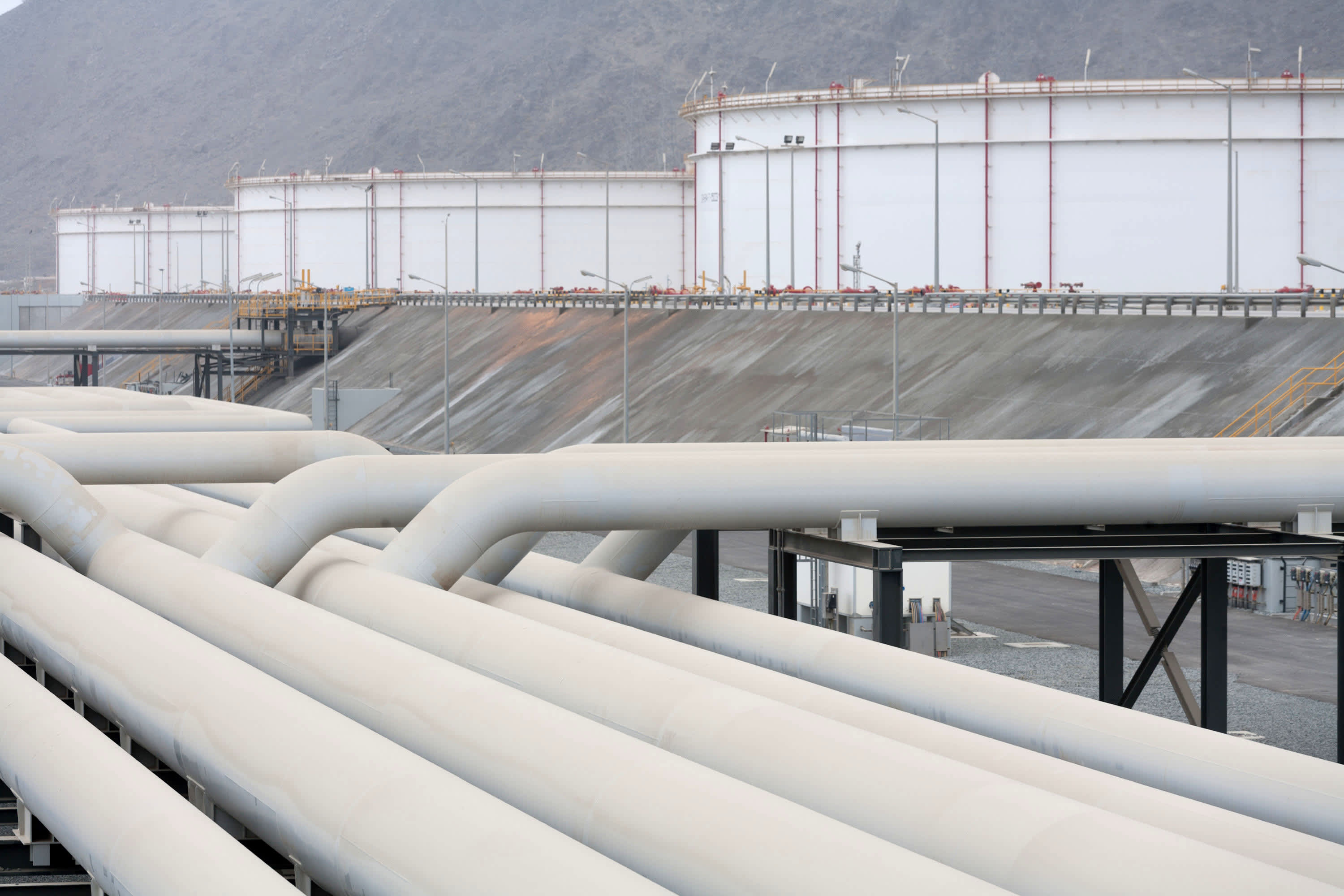
The effective closure of the Strait of Hormuz has abruptly thrust two alternative oil pipelines into the global spotlight, one in Saudi Arabia and another in the United Arab Emirates.
The first is Saudi Arabia’s East-West pipeline network, or Petroline, a roughly 750-mile system that transports crude across Saudi Arabia, connecting Abqaiq on the oil-rich kingdom’s eastern Gulf coast to the port of Yanbu on the Red Sea.
The East-West pipeline is estimated to have a total design capacity of 7 million barrels per day, following recent expansions, and Saudi oil giant Aramco said earlier this week that it expects the network to reach full capacity over the coming days.
The second smaller pipeline is the UAE’s Abu Dhabi Crude Oil Pipeline (ADCOP), or the Habshan–Fujairah oil pipeline. Spanning around 248 miles from onshore oil facilities at Habshan to Fujairah, the pipeline is estimated to handle 1.5 million barrels per day, with a reported total capacity of close to 1.8 million barrels per day.
Crucially, both alternate pieces of Gulf infrastructure bypass the Strait of Hormuz, a vital oil choke point which has been blocked since the U.S. and Israel launched strikes against Iran on Feb. 28.
Iran has retaliated by targeting ships trying to pass through the narrow maritime corridor, with several incidents reported in recent days.
Taken together, energy analysts said the East-West pipeline and ADCOP could help to partially offset the nearly 20 million barrels per day that typically transit through the Strait of Hormuz. The risk of infrastructure damage amid the sprawling Middle East crisis, however, remains an ongoing challenge.
“Saudi Arabia and the UAE are already increasing utilisation of pipelines that bypass the strait,” Naveen Das, senior oil analyst at global trade intelligence company Kpler, told CNBC by email.
“In the UAE, we estimate the 1.5 mbd ADCOP pipeline is operating at 71% utilization, leaving around 440,000 [barrels per day] of spare capacity. ADNOC can temporarily raise throughput to 1.8 mbd if required,” Das said.
He added that the prospect of attacks on energy infrastructure across the country could limit this total capacity estimate.
Indeed, Abu Dhabi state oil giant reportedly closed its massive Ruwais refinery in response to a fire at a facility within the complex, according to multiple media reports, citing unnamed sources. CNBC has contacted a spokesperson at ADNOC and is awaiting a response.
The UAE’s Ruwais complex is estimated to be able to process 922,000 barrels of crude per day.
“With crude supply increasingly stranded in the Gulf, refiners may soon be forced to adjust operations, curtailing runs as product exports stall and directing output solely to domestic markets,” Pankaj Srivastava, senior vice president at energy research firm Rystad Energy, said in a research note.
“The UAE’s Abu Dhabi Crude Oil Pipeline (ADCOP) allows crude exports to bypass the Strait via Fujairah, but refined products from the Ruwais complex still largely depend on tanker routes that transit Hormuz,” Srivastava said Thursday.
“As a result, UAE refineries may still need to adjust product exports or manage inventory build-ups if maritime flows remain restricted,” she added.
Energy market impact
Oil prices have been extremely volatile since the outbreak of the Iran war last month, with global benchmark Brent crude rallying to nearly $120 a barrel at the start of the week, before falling back to around $90.
Crude futures were last seen trading near $100 a barrel on Thursday morning as further attacks were reported on ships in the Persian Gulf.
“The longer this conflict goes on, the more these storages fill up and there’s nothing to do but production cuts,” Sasha Foss, energy market analyst at Marex, told CNBC’s “Europe Early Europe” on Wednesday.
He estimated that Iraqi oil production had fallen by as much as 70% due to the Iran war and warned that further production shut-ins could send oil prices even higher.
“When we see the likes of Saudi Arabia and UAE trimming, that’s when it is really going to hit global oil markets hard,” Foss said.
Source: CNBC